
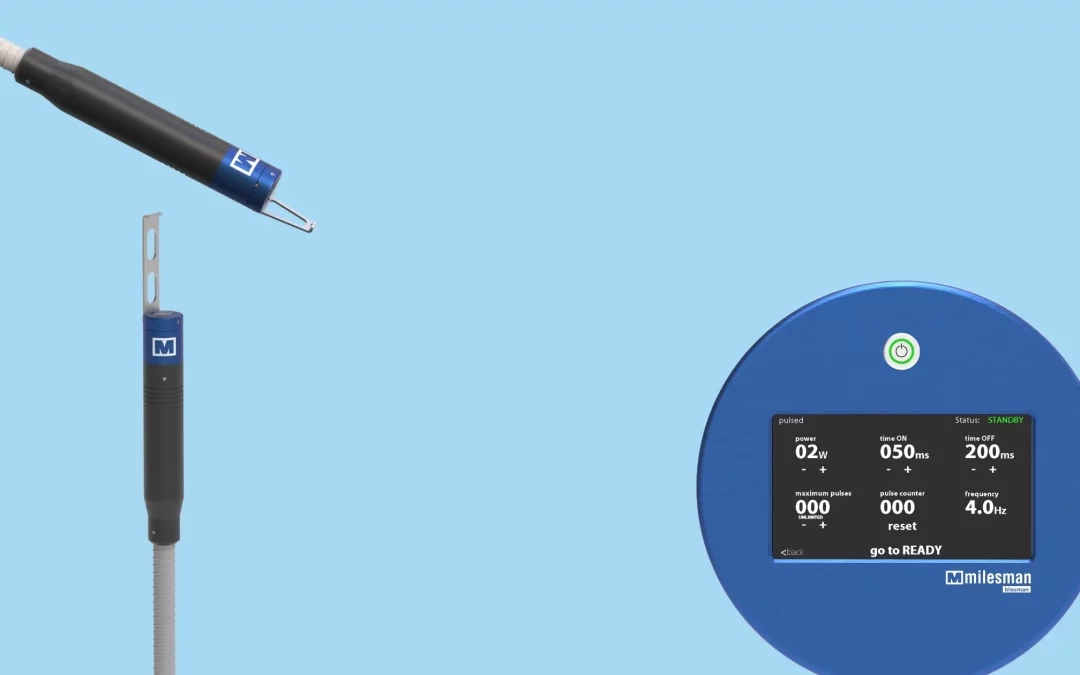
450 nm blue laser:
precision versus expectations
The 450 nm blue laser, such as milesman Blauman, has been well established in aesthetics and aesthetic medicine for years with a very specific goal: to treat benign skin lesions with precision, address active acne, and safely improve the overall appearance of the skin.
In recent months, this technology has once again been in the spotlight. And with it, messages have also appeared that do not always accurately reflect what happens in the skin. That is why it is worth pausing to analyze it from a place of knowledge. This article is aimed at professionals who want to be clear about:
- what the blue laser really does
- where it adds value
- and what its limits are
Because that is where sound judgment is built.
A technology developed with a clear purpose
The development of the 450 nm blue laser within milesman stems from a simple idea: to work on the surface with a level of precision that is hard to achieve with other wavelengths. That was the starting point of Miguel Galán’s work and also the approach that has guided the evolution of the device: improving control, fine-tuning parameters, and adapting the technology to the real-world practice of aesthetics and aesthetic medicine.
How the 450 nm blue laser behaves
The behavior of the 450 nm is very well defined. It shows high absorption by hemoglobin, an affinity for melanin, and limited penetration, around 1–1.5 mm. This means its action is concentrated in the epidermis and papillary (superficial) dermis. It is not a wavelength meant to work at depth. It is a wavelength designed to work with precision on the surface.
What it makes possible in practice
When used within that framework, the blue laser delivers consistent, predictable results. It allows superficial tissue to be removed in a controlled way, which makes it especially useful for benign lesions such as:
- seborrheic keratoses
- skin tags
- sebaceous hyperplasia
- milia
- fibrous papules
- lentigines
In superficial vascular lesions, it acts on hemoglobin, producing a selective coagulation of small vessels, as occurs with cherry angiomas or fine telangiectasias. These are precise, fast procedures with a short recovery, which makes it easy for the client to return to their usual activities right away.
Medical applications: the role of diagnosis
The blue laser also has applications in the medical setting. But here it is worth remembering something essential: it is not the technology that defines the treatment, it is the diagnosis. Indications such as xanthelasma, syringomas, superficial angiomas, molluscum contagiosum, mucosal lesions, or nail pathology require medical management. The laser is a tool. The judgment comes from the professional.
Understanding its limits
The interest this technology has sparked has led, in some cases, to it being associated with concepts such as skin tightening, skin retraction, or deep rejuvenation. This is where it pays to be especially precise.
The 450 nm blue laser does not produce clinically relevant skin retraction.
Why?
For a real tightening effect to occur, it is necessary to act on the reticular dermis, where collagen remodeling takes place. This means working at depth and generating a sustained thermal stimulus. Because of its physical characteristics, the 450 nm blue laser does not reach that level of action. Its effect is limited to superficial layers, with no thermal deposition in the areas responsible for structural tightening.
What is actually seen
After the treatment, the skin can visibly improve:
- more even texture
- a cleaner appearance
- greater radiance
This improvement is real, but it responds to superficial processes. It does not involve a deep structural change. That is why it is important to distinguish: improving the skin is not tightening it.
When it is used outside its indication
The problem is not the technology, but the way it is used. When the 450 nm blue laser is applied over large surfaces with the intention of achieving a tightening effect, it is being taken away from its operating logic. In that context, the following can appear:
- crust formation over extensive areas and a longer recovery
- disruption of the skin barrier and a higher risk of infection
- post-inflammatory hyperpigmentation, especially in certain skin phototypes
- pigmentation changes in cases of repeated damage
All of this without having reached the deep dermis, where true tightening would take place.
A decision based on knowledge
During the development of the device, different ways of using it have been explored. That is part of any serious process. And it is precisely that experience that makes it possible to set limits with sound judgment. Not everything that is technically possible is appropriate from a clinical standpoint. That is why tightening or retraction protocols are not developed or promoted with this wavelength.
Where its value really lies
The blue laser does not need to do more to be an excellent technology. Its value lies in what it already does well:
- treatment of selected benign lesions
- addressing acne
- visible improvement in skin quality
When used in that context, it offers precision, safety, and exceptional results.
Working with honesty
In an environment where it is easy to oversimplify the message, the difference is made by those who understand the tool they are using. Clearly explaining what a technology does is not a limitation. It makes it possible to work safely and build trust.
Looking to the future
The sector is evolving and so are its needs. We are listening to you. We know what you are looking for. We know where you want to go. And it is part of our work to keep researching and developing solutions that meet that demand with clinical consistency, safety, and proven results.
Recent Comments