
Updated on 22/01/2026. All the questions and answers about the blue laser
The milesman Blauman blue laser at 450nm has become an essential tool for aesthetic professionals. In this complete guide we answer the most frequently asked questions about its applications, benefits, treatment protocols and comparisons with other laser technologies.
1. What is the blue laser and what is it used for?
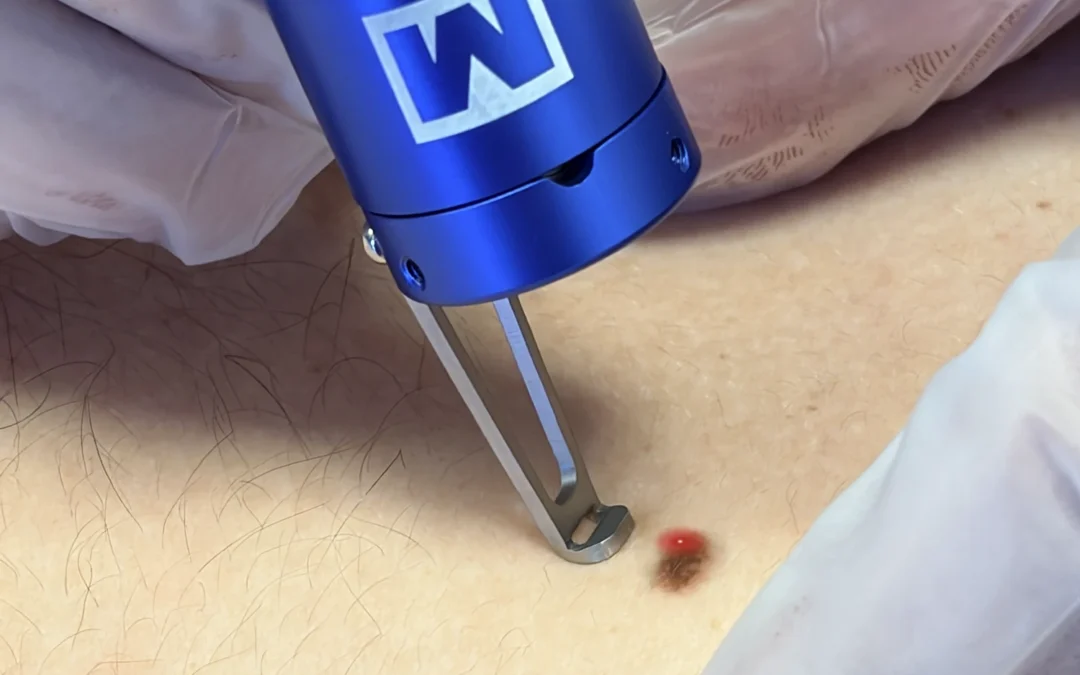
The milesman Blauman device is a 450 nm diode laser for aesthetic use. It is a precision technology designed to treat a wide variety of benign skin lesions, always safely and effectively. It works through the principle of selective photothermolysis, which allows light energy to be absorbed only by chromophores, such as the melanin present in pigmented lesions or the haemoglobin of small blood vessels, without damaging the surrounding tissue.
Thanks to this selectivity, the blue laser is used to remove benign lesions such as lentigines, seborrhoeic keratoses, skin tags, fibrous papules and benign naevi, as well as milia cysts or sebaceous hyperplasias. In addition, it acts directly on small superficial vascular lesions, such as telangiectasias and cherry angiomas, coagulating fine vessels and making them disappear without bleeding and with rapid recovery.
Blue light has a bactericidal effect, damaging Cutibacterium acnes, which reduces breakouts and improves skin texture in clients with active acne.
Because of its versatility and precision, the blue laser has established itself as a powerful tool in aesthetics, with more than 7 years of clinically proven results, guaranteeing confidence both for the professionals who use it and for the clients seeking effective and safe solutions to improve the health and appearance of their skin.
2. How many blue laser sessions are needed?
In the case of superficial benign lesions, most of the time a single session is needed to completely remove the lesion.
For active acne, the protocol usually requires several initial sessions spaced two weeks apart, with subsequent maintenance sessions every 4–8 weeks.
In the case of vascular lesions such as telangiectasias and cherry angiomas, clients achieve the desired result between the first and third session.
In any case, a prior assessment is required.
3. Which laser is better, green or blue?
Choosing between a blue or green laser is not a question of which is better in absolute terms, but of what it will be used for and what the aim of the treatment is.
The 450nm blue laser, such as the milesman Blauman, is for aesthetic use, indicated mainly to treat benign lesions and active acne. Its wavelength allows a precise effect on melanin and superficial haemoglobin, and its bactericidal action makes it perfect for facial treatments where the goal is to improve texture, eliminate acne breakouts and treat small visible imperfections, without affecting the surrounding tissue.
For its part, the green laser, generally 532 nm (KTP), is a laser for medical use, deeper, employed mainly to treat vascular alterations and higher-density pigmentations. Its greater penetration allows it to act on the deeper microvasculature, ideal for specific clinical cases, with therapeutic results that go beyond superficial aesthetic care.
The choice between blue and green depends on the type of lesion and the depth of the pigments or vessels to be treated. An aesthetic professional will choose the blue laser for its safety, speed and effectiveness in aesthetic treatments, while the green laser is reserved for a deeper medical approach.
4. What benefits does blue light have on the skin?
The blue light of the milesman Blauman 450 nm laser offers benefits that combine clinical and aesthetic effectiveness, improving both the appearance and the health of clients’ skin.
It makes it possible to remove benign lesions, such as lentigines, seborrhoeic keratoses, fibrous papules, skin tags, sebaceous hyperplasias and milia cysts in a precise and controlled way, promoting rapid regeneration and minimal discomfort. This action is combined with the selective coagulation of superficial vessels, such as telangiectasias or cherry angiomas.
Another benefit is its bactericidal effect, which reduces inflammatory breakouts and improves skin texture in clients with active acne. This provides an immediate result in terms of lesion reduction, and it also prepares the skin for complementary aesthetic treatments.
The blue laser allows fast, safe and virtually painless treatments, with minimal recovery, ideal for clients who want visible results without interruptions to their daily routine. Its use is validated by more than 7 years of experience and guarantees effectiveness and safety in the results, establishing itself as a reference tool in professional aesthetics.
Overall, the benefits of blue light translate into more uniform, healthier and aesthetically improved skin, and the aesthetic professional offers a high-value service, capable of building client loyalty and setting their centre apart in the market.
5. What are the side effects of the blue laser?
The 450 nm blue laser is generally very safe, but like any aesthetic treatment that acts on the skin, it can cause temporary side effects that are completely normal and expected.
Among the most frequent effects are mild redness, a sensation of heat or slight localised inflammation, which usually disappears within a few hours or days. In cases of treating benign lesions, a thin superficial crust may form that comes off naturally without leaving a mark.
More serious effects, such as burns, scars or temporary pigmentation changes, are rare and generally occur when the laser parameters are not adjusted correctly or the application is carried out by an untrained aesthetic professional.
The side effects are minimal, transient and easily manageable.
6. Is a blue laser any good?
Yes. The milesman Blauman blue laser 450 nm is a proven and effective aesthetic technology, with more than 7 years of clinical and aesthetic experience.
Among its main advantages is the speed of the treatments. This translates into greater profitability for the professional.
Why is it considered an especially good laser in aesthetics?
Because it combines three qualities at the same time: precision, speed and versatility.
The blue laser is not only good; it positions itself as a tool for any aesthetic professional seeking effectiveness, visible results and client satisfaction, all backed by years of clinical evidence and experience in the sector.
7. What does the blue laser remove?
The milesman Blauman blue laser removes benign skin lesions, such as lentigines, skin tags, fibrous papules, naevi, seborrhoeic keratoses, sebaceous hyperplasias and milia cysts.
In addition, its bactericidal effect acts on the acne bacterium and makes it an effective tool for facial treatments. It improves the overall condition of the skin and facilitates deep cleansing.
It also acts on vascular lesions, such as telangiectasias or cherry angiomas.
8. Blue light: does it stimulate collagen or does it have another aim in aesthetics?
Blue light does not have to stimulate everything
In advanced aesthetics, each wavelength has a specific function. And it should be said clearly: blue light is not intended to stimulate collagen, nor is it a reference wavelength for that purpose.
Why?
Because the biostimulation of fibroblasts and the synthesis of new collagen are associated above all with wavelengths in the red and near-infrared range, typically above 620 nm, capable of reaching the dermis at greater depth.
Blue light works at around 450 nm, with a much more superficial and selective action.
And that is precisely where its value lies.
It acts mainly at the epidermal level, where the skin needs regulation and control.
It has a powerful antibacterial effect, especially useful in acne and imperfections.
It is highly effective in the treatment of multiple superficial benign skin lesions, where low penetration is an advantage.
By not generating deep heat or seeking an intense response in the dermis, blue light respects the dermal architecture and makes it possible to act with precision when the aim is not to regenerate or stimulate collagen, but to regulate, control and specifically treat superficial structures.
The result?
More balanced skin, with a healthy skin environment that favours the natural repair processes, without forcing biological responses that do not correspond to the indication of this wavelength.
In technologies such as milesman Blauman, blue light does not try to do everything: it is designed to act exactly where it is truly effective —acne, superficial benign lesions and regulation of the skin environment— when used with professional knowledge and judgement.
Because in professional aesthetics, it is not all about stimulating: true expertise lies in knowing which wavelength to use, when to use it… and when not to.
9. When is it not advisable to use a laser?
Although the milesman Blauman 450 nm and milesman Compact 810 nm aesthetic lasers are safe and effective, there are situations in which they should not be used. Among the main contraindications are pregnancy, coagulation disorders, abnormal healing, a tendency to keloids, active infections, open wounds or acute inflammation in the area.
The recent use of oral isotretinoin makes laser treatments inadvisable. Tanned or photosensitive skin, whether from the sun or photosensitising medication, is also a contraindication. Other cases include active oncological diseases, photosensitive epilepsy and the presence of tattoos and micropigmentation in the area.
Professional reviews
“Fast and effective treatments. I have been working with the device for a year and I am very happy. The results of the Blauman Blue Laser are spectacular.”
– @It_centro_estetica
Do you want to see real results?
Recent Comments